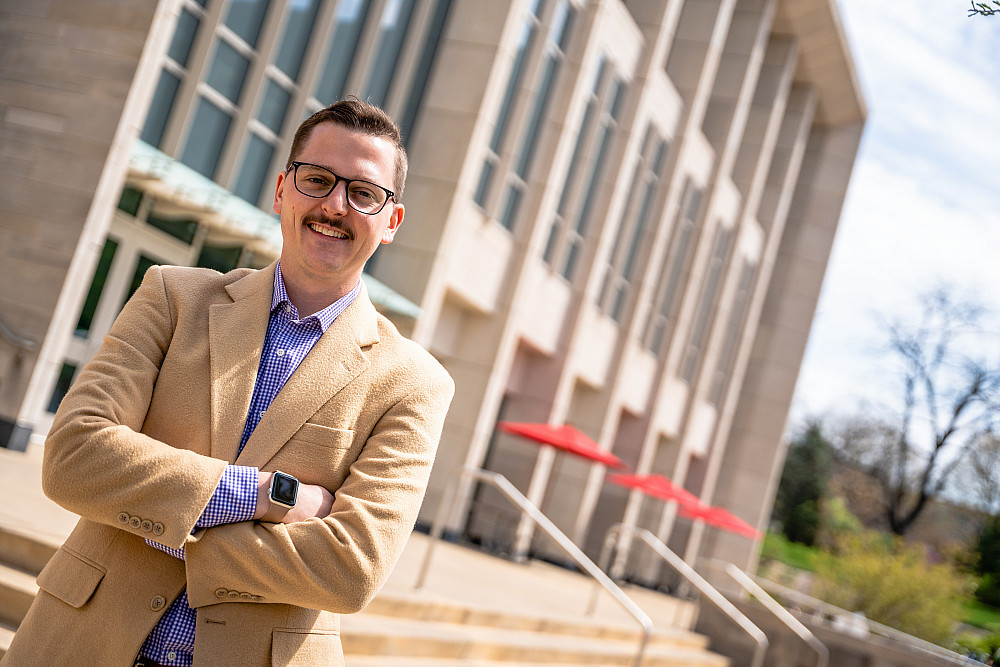
The world is quickly racing for solutions to new environmental challenges. However, vulnerable communities are often left behind, experiencing the most negative impacts. Cody Smith, a recent graduate of Indiana University’s top-ranked O’Neill School of Public and Environmental Affairs’ Master of Public Affairs program in Bloomington, is empowering the voices of those who have been disenfranchised.
Informing a philosophy
Smith grew up on a sheep farm in Crawfordsville, Indiana, that had been in his family for generations. Behind it was a large pond that became the centerpiece of his childhood. While there were joyous memories filled with family events, he also recalls that the pond had an odor, discoloration and an overgrowth of moss and algae. The main culprit: phosphorous.

Choosing to go to college was tough. Smith, a first-generation college student, didn’t want to leave his mother, who struggled with substance use disorder, but he knew college would give him the opportunity to pursue his passion and make a difference.
“I wanted to have a fresh start, to figure out how to help people thrive by bettering their environment,” Smith said.
After completing his bachelor’s degree at Iowa State University, Smith worked at the Nebraska-based Center for Rural Affairs, whose mission focused on the Midwest. While there, he recognized the need to increase his foundational knowledge. He said he was pleasantly surprised to discover a dedicated public policy and environmental affairs school featuring a top-ranked MPA program in his home state.
“I wanted to study environmental policy without having to pick between energy and water,” Smith said. “With O’Neill, I could create a specialized concentration that included both.”
A firm foundation
Attending O’Neill brought him back to Indiana, but tragedy soon struck. Within his first six weeks at school, his mother passed away from a drug overdose.
“Dealing with her death was difficult,” Smith said. “Loving someone who struggles with substance abuse has been a part of my experience throughout my educational journey. My friends and community at the O’Neill School were fantastic during that time.”
Despite the personal hardship and with the support of the faculty and his peers, Smith flourished in the MPA program. That included being a member of the first cohort of Environmental Justice Fellows with Lynton K. Caldwell Professor David Konisky, where Smith worked with community leaders who organize people against environmental injustice.
“I enjoyed my time at the O’Neill School so much,” he said. “The people around me were incredible, especially the faculty with their knowledge, expertise and willingness to dive in on the practical implications of everything discussed.
“The way I learned best was to go out to these projects. It’s easy to misbelieve something about wind or solar projects if you’ve never been to one. Being able to see them in person and have those experts available was invaluable.”
Hands-on experiences, such as the Environmental Justice Fellows, are essential for students pursuing careers in environmental policy because they provide practical skills, real-world challenges and a variety of learning opportunities. Internships, field courses, research projects and service-learning programs allow students to apply their classroom knowledge to environmental issues and solutions.

- Serving as deputy project lead on an assignment with the U.S. State Department, under the advisement of Clinical Associate Professor Emeritus John Rupp. Smith examined the country of Turkmenistan, advising the ambassador on how to reduce methane emissions produced by the country’s oil and gas sector.
- Serving as a community resilience coordinator at the IU Environmental Resilience Institute. Smith helped administer the Hoosier Resilience Index, a tool that helps local governments in Indiana conduct a vulnerability assessment of their preparedness for climate change impacts.
- Participating in the O’Neill Global Leadership Program. He spent a summer in Brazil helping their federal government with water resources management.
- Participating in the O’Neill International study abroad program. Smith traveled to the Cayman Islands, studying marine life and coral reefs.
- Founded the O’Neill Environmental Professional Students Association to organize even more on-site environmental visits and host networking events.
“At one OEPSA dinner, our keynote speaker was Christina Motilall, from the Office of Environmental Justice at the U.S. Environmental Protection Agency,” Smith said. “She is an O’Neill alum. We were thrilled to have her return to campus and dialogue. I still rely on those connections, and I have them because of O’Neill.”
A greener tomorrow for all
After graduating, Smith became a senior policy advocate for the Iowa Environmental Council. He develops programs to make sure members of vulnerable communities receive the benefits they are owed.
His work empowers communities to solve their unique environmental challenges. He said the biggest challenges ahead for the Midwest are:
- Energy transition: Communities that have been historically marginalized are often overlooked as it relates to renewable energy benefits.
- Vulnerable communities’ access to funding: Many of the communities that need federal grant dollars the most don’t have the staff, tools and resources to obtain it.
- Building a resilient economy: When a major natural or environmental disaster occurs, economic activity is stalled. Therefore, it is vital to build resilient infrastructure.
Indiana University has mobilized its resources to address these challenges in the state and across the Midwest. The Environmental Resilience Institute offers the McKinney Midwest Climate Project which connects undergraduate and graduate students interested in climate, sustainability and community resilience with career experiences. The goal is to prepare leaders to work alongside communities so they can be resilient in the face of environmental threats.
The O’Neill School has partnered with the School of Public Health-Bloomington and the College of Arts Sciences through various academic programs to prepare the next generation of scientists, policymakers, communicators and leaders who face significant and complex environmental and sustainability challenges.
“I am so fortunate to have this education,” Smith said. “Throughout my career, I aim to work with the communities that are most impacted. We can include them in the decision-making process and think about how each choice will change their everyday lives. For me, that is the core of environmental justice.”