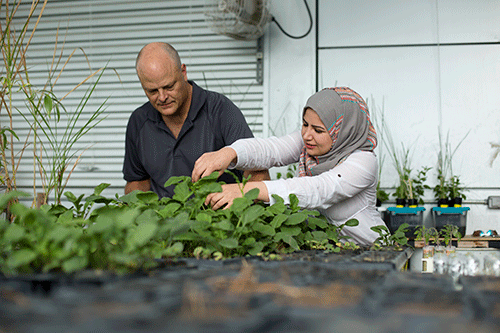
Several scholars have investigated the utility of undergraduate research and its role as an access point for minoritized students. For example, Bhattacharyya and colleagues (2020) found that course-based undergraduate research broadened the pathway to STEM fields for minoritized student groups. Carpi and colleagues (2017) noted that undergraduate research was a “powerful equalizer at [minority serving institutions] MSIs” (p. 169). In addition, studies have shown that there is a positive relationship between minoritized student participation in undergraduate research and their academic outcomes (Collins et al., 2017; Kinzie & BrckaLorenz, 2021; Roger et al., 2012).
Given the utility and benefits of participating in research with a faculty member outside of class, it is essential to examine the factors contributing to undergraduate research participation to get more students, especially minoritized students, involved to have better academic outcomes. Building on several existing studies that examine student participation in undergraduate research, this study aims to explore factors that predict the participation in undergraduate research for students majoring in STEM fields, focusing on minoritized student populations.
In this study, we applied Astin’s student involvement theory and the Input Environment Outcome (I-E-O) model to understand college and its influence on students as our theoretical framework. The theory explains how colleges affect students based on three categories: inputs, environments, and outcomes (Pascarella et al., 2016). The data for this study comes from the 2019 and 2020 administrations of the National Survey of Student Engagement (NSSE).
Some highlights from the results include:
|
Biological Sciences |
Engineering |
Physical & Computer Sciences |
|
|
|
|
|
|
Note. “+” indicates students were more likely to participate in undergraduate research; “-“ indicates students were less likely to participate in undergraduate research.
In April 2022, we presented our study at the American Educational Research Association (AERA) annual conference, and those slides can be found here. https://scholarworks.iu.edu/dspace/handle/2022/27737
References
Bhattacharyya, P., Chan, C., & Waraczynski, M. (2018). How novice researchers see themselves grow. International Journal for the Scholarship of Teaching and Learning, 12, 3.
Carpi, A., Ronan, D. M., Falconer, H. M., & Lents, N. H. (2017). Cultivating minority scientists: Undergraduate research increases self‐efficacy and career ambitions for underrepresented students in STEM. Journal of Research in Science Teaching, 54(2), 169-194.
Collins, T. W., Grineski, S. E., Shenberger, J., Morales, X., Morera, O. F., & Echegoyen, L. E. (2017). Undergraduate research participation is associated with improved student outcomes at a Hispanic-serving institution. Journal of college student development, 58(4), 583.
Kinzie, J., & BrckaLorenz, A. (2021). Expectations for and quality experiences in undergraduate research over time: Perspectives of students and faculty. Journal of the Scholarship of Teaching & Learning, 21(1), 35–56.
Pascarella, E. T., Mayhew, M. J., Rockenbach, A. Bryant, Bowman, N. A., Seifert, T. A., Wolniak, G. C., & Terenzini, P. T. (2016). How college affects students: 21st century evidence that higher education works. Jossey-Bass.
Rogers, D. L., Kranz, P. L., & Ferguson, C. J. (2012). A strategy for involving undergraduates in research. Journal of Hispanic Higher Education, 11(1), 55-66.